
A Biotech Founder Walks Into the Personal Care Industry.
“I think I broke my back. Get me out of the car.”
That was the last thing I ever said on a race radio.
It was 2021. I was co-founder and CEO of Recursion, a biotech company using AI to discover new medicines, and I had just taken us public in the middle of a pandemic. I was working well over 100 hours a week. And yet the only place I felt at peace was in a race car at 150 mph, where there is no room in your head for anything but the moment.
That was the entire appeal.
Chasing the leader from second, a gust of wind upset the car as I rounded a high-speed, high-downforce corner. I lost focus for a fraction of a second, which was enough to matter. Moments later, I hit the inside barrier head-on.
Two compression fractures in my spine, thankfully with the spinal cord untouched. Months in a hard turtle-shell brace. A half inch of height I will never get back.
My wife’s face in the trackside clinic told me I wouldn’t race again. My chairman, whom I called from the ambulance on the way to the hospital, landed the gut-punch: “After you heal, let’s think up some hobbies more appropriate for a public company CEO.”
He was right. But I’d just lost the one thing that felt like self-care.

Prepping for a 6-hour enduro race in the Summer of 2021, before the accident.
Everything that wasn't the company got triaged
I was in the office Monday morning, 36 hours after the crash, brace on and no pain medicine. Recursion was scaling and I had work to do: a massive partnership with Roche to negotiate, hiring like mad, acquisitions across the globe.
I’d traveled a lot before, but I wasn’t prepared for the years of living out of a suitcase that followed as we opened offices in Canada and the UK. Workouts largely fell out of my routine. My own health became something I would get back to when things settled down.
Things did not settle down.

I was traveling the globe doing deals on behalf of the company as my self-care routine slipped further and further away
A skin condition I’d had for years flared badly. The diagnostic odyssey is another story; the short version is that I became obsessive about what I put on my skin.
I stopped using whatever was in the hotel and hauled my own shampoo, conditioner, and body wash to every city, decanting another 100 mL into travel bottles every time I got home. I went through dozens of travel organizers without landing on something capable. I made the late-night walk of shame to CVS more times than I’d like to admit because I’d forgotten to refill something, and opened my bag to an exploded bottle more times than that.
I was flying constantly to run a company built on precision, carrying a toiletry bag assembled with none.
It was an annoyance, not a business idea. After all, I had a company to run.
 The travel bag in question
A side project, with permission
In 2024, I realized I needed to start taking better care of myself if I wanted to keep showing up for all the roles in my life. I got back to training and finished my first Ironman in over a decade. I also decided to step back from leading a global public company in favor of something smaller and closer to my sweet spot.
I was incredibly fortunate to find and hire a successor for the company I had founded.
On January 1, 2026, the day after I stepped down as CEO, I told my family I wouldn’t start anything serious for at least six months.
But once an entrepreneur, always an entrepreneur. I needed something to build.
So while the kids were at school, fixing the friction of that annoying travel bag became a fun side project with my brother, Riley Gibson, who has spent his career leading consumer brands. He knew the consumer business. I knew how to ask an unreasonable number of questions. It seemed like a good combination.

An early brainstorming session with Riley
The idea was deliberately narrow. There were plenty of personal care products in the world. We would focus on the vessel—the system that carries and organizes them—and fill it with the best existing formulas we could find.
That innocent start led to a conversation with Ian Callum. If you’re as nutty about cars as I am, the name will ring a bell. Ian’s career includes some of the most recognizable Aston Martins and Jaguars ever built. He now runs his own studio, CALLUM, and together with his team we began iterating across two continents.
Slowly, a very special design took shape. This work may not have felt as impactful as trying to cure diseases, but I wanted a break from the serious stuff, and I was having fun again.
Then we went looking for the personal care formulations to put into the product.

Ian Callum next to the Aston Martin DB9 he helped design
“We only need to put a drop in”
Contract manufacturers keep libraries of finished personal care formulas: hundreds of shampoos, cleansers, moisturizers, and sunscreens. Already developed. Already costed to the cent.
I expected those meetings to go quickly. I’m a PhD-trained bioengineer who spent more than a decade at the frontier of drug discovery, and I was not looking for another chemistry project.
In one of our very first meetings, a senior executive with a scientific degree was explaining how we could get a fashionable active onto our label.
“We only need to put a drop of it in each batch to make the claim,” he said.
He wasn’t being cynical. He was being helpful, walking a newcomer through an approach I would encounter again. I later learned that cosmetic chemists have a name for it: “fairy dusting.”
The phrase stayed with me.
An ingredient can have real published research behind it. But that research doesn’t automatically tell you what a finished product will do. The concentration matters. The formulation matters. What was actually tested matters.
From the front of a bottle, those distinctions can be very hard to see.
None of this means cosmetics and personal care products can’t work. Some work beautifully. But a product formulated around a meaningful amount of an ingredient can look remarkably similar to one containing just enough to matter only in the marketing.
I had spent my career trying to get the right molecule to the right place at the right dose. I couldn’t suddenly stop caring about the dose because the molecule was going into a moisturizer.
Riley knew from the look in my eyes coming out of that meeting that we were in for a bigger build than we’d planned.
After years of trying to understand what in my own everyday products might be hurting my skin, there was no version of this where we put our name on something we didn’t understand deeply.
Not a garage startup. A kitchen one.
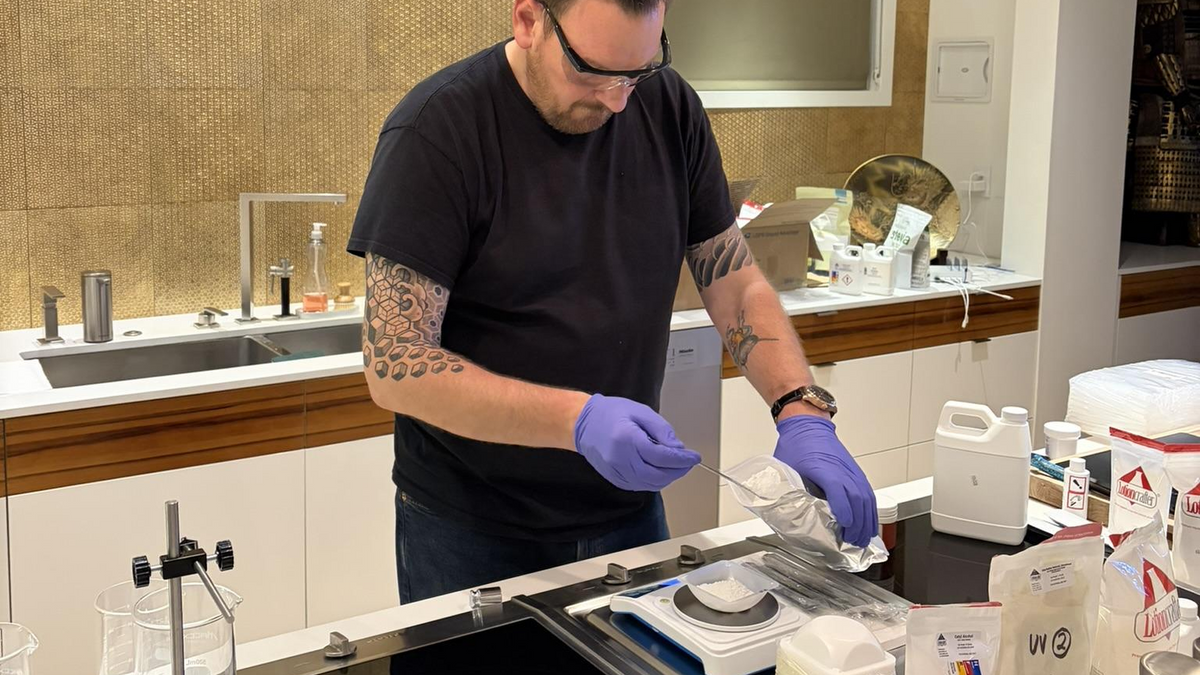
So I turned my kitchen into a personal care laboratory.
I read the literature behind every category, shampoo to toothpaste, looking at safety, the concentrations of various ingredients studied, and the limits of what the evidence could tell us. I learned, through a great deal of trial and error and a very patient family, to make emulsions.
We iterated, over and over, and tried the early formulations ourselves. Eventually, we brought in a cosmetic chemist to help us tune the look and feel.

Our first laboratory in my kitchen
That part mattered more than I had initially appreciated. Understanding a formula is essential. So is loving the way it feels on your skin when you use it so you want to apply it again tomorrow.
Riley was asking what the experience should feel like. I was asking what every ingredient was doing there. Those questions started to improve each other.
Our work with perfumer Craig Andrade of The Raconteur brought that into focus. Fragrance needed to earn its place, too. Its purpose was in how the moment of care felt: the anticipation before an important meeting, or before the lights go out and it is time to act.
We were learning that taking care of yourself could be precise and pleasurable at the same time.
The same was true of the hardware. We wanted to eliminate the decanting, leaking, and rummaging. But we also wanted the product to feel good in your hand, the modules to connect with a satisfying click, and the system to be something you would want to keep.
The brief was growing. So was our understanding of what we were actually building. Science and luxury were a part of each of our conversations.
The part of racing I had missed
Riley and I caught the racing bug from our father, another busy executive who still races cars. And the more we designed for people like ourselves, always in motion, the more the sport kept coming back.
Here is the thing about my crash. I had been treating racing as the one way I could find some peace. When I lost it, an important piece of my self-care ritual disappeared with it.
The sport, it turns out, had a better model all along.
In an F1 pitstop, around twenty people change four wheels in as little as two seconds. It is one part ballet, one part process engineering, and one part athletics. Everything has been considered before the car arrives.
The car cannot keep performing unless someone takes care of it.
I had somehow understood that about a race car without applying it to myself.
That became the idea behind BOXBOX: a personal care system for men who live their lives in motion. Refillable skin, hair, and oral care essentials, designed together with the system that carries them and with equal parts science and luxury.
Something familiar at your own sink, in a hotel bathroom, or after a workout. Quick when it needs to be. Worth spending time with when you have it.
We named it after the radio call that brings a car into the pits: "Box Box."

Boarding a flight to the Melbourne Grand Prix to explore the potential of F1 as our GTM strategy
BOXBOX is the everyday set of personal care: hair, skin and sun, and the system that organizes and carries it (TSA-compatible, of course).
We started ideating around this project in February of this year and by May it was obvious that F1 wasn't a parallel passion of ours; it was the proving ground. Teams travel to 24 races on five continents in nine months, one of the few groups on earth who move more than the executives I used to sit next to on planes. And the paddock is one of the few places in the world where serious science and ultimate luxury are held in the same regard.
So we went to the Miami Grand Prix and met with seven teams, looking for the one that would work most closely with us as a partner. A few really understood what we were building and why F1 was the place to bring it to life. And I’m happy to share that several weeks ago we signed a fantastic partnership with a Formula One team.

Riley and me in front of one of many F1 team garages during the Miami race weekend
Putting our assumptions under pressure
Riley delivered our first working prototype systems to our new partners at Monza a few weeks ago. And the feedback has already made us revisit decisions we thought we had settled.
People liked having their essentials connected and in one place. They liked the aluminum and the click. But a module that felt substantial in the hand became heavy when several were packed together. Buttons could be pressed accidentally in transit. Some people found the connection mechanism more obvious than the dispenser.
We knew the prototypes so well that we had stopped seeing some of those problems.
The team hadn’t.
That feedback is driving changes to weight, depth, dispensing, and travel protection. The next versions go back into use, and we learn again.
That is how we intend to earn “Paddock Grade Personal Care.” Through the ordinary, demanding experience of people reaching for it day after day—and through what we do when they tell us something isn’t good enough.
An ask
Soon, we’ll open that same feedback loop to more people who know this life: a bag that is always half-packed, another early flight, and good intentions about taking care of yourself that don’t always survive the schedule.
I would rather build this with a few hundred honest critics than a million passive fans.
If that sounds like you, sign up at boxbox.com and follow the build. Tell us what you carry, what frustrates you, and what you wish somebody would finally fix.
I didn’t expect an annoying travel bag to bring me back to the laboratory bench. Or a kitchen experiment to bring me back to car racing.
But I know what it feels like to keep showing up for everything except yourself. And I think we can make taking care of yourself easier to keep doing, wherever life takes you.
The last thing I ever said on a race radio was “get me out of the car.”
It is fitting that the next thing I build is named for the call that brings you in on purpose.
We are BOXBOX.
BE READY.