
Function is Our Luxury: Designing a Form for Ritual and Efficiency.
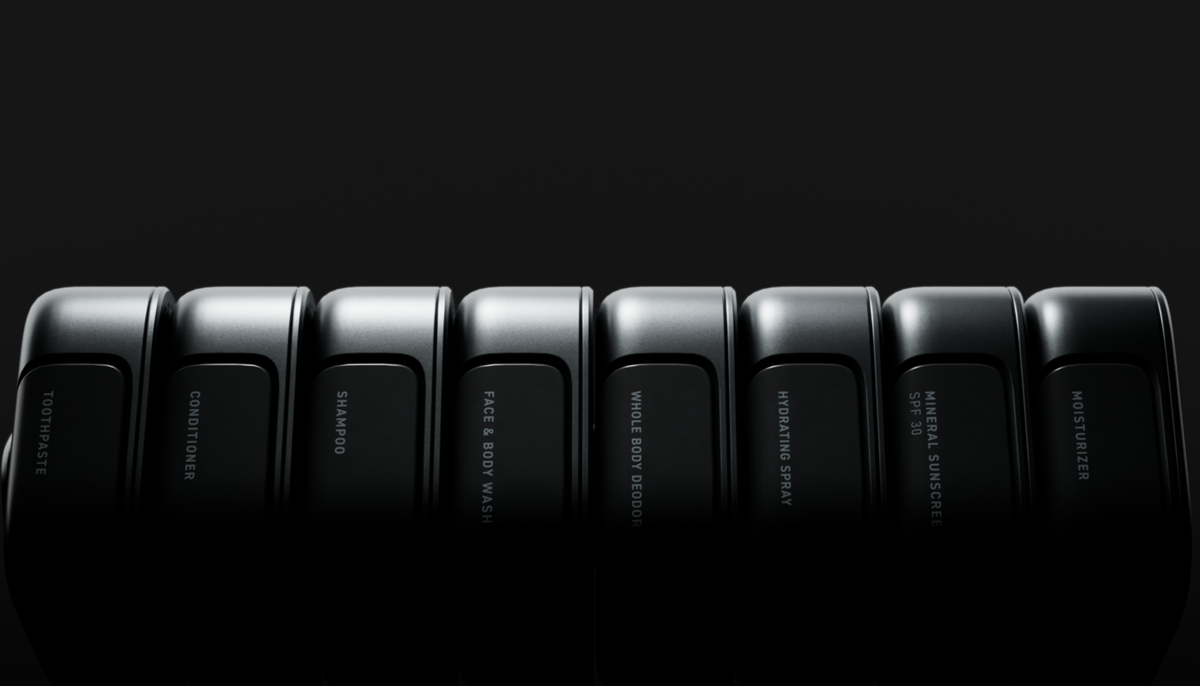
Designing a daily ritual with Callum Design and testing it with the Aston Martin Aramco Formula One Team.
A ritual that moves with you
BOXBOX started with a small frustration that kept repeating itself. We are parents of young kids who travel more than we'd like, and we noticed the same thing whether we were boarding a flight, leaving the gym, or standing in the sun at a school pickup realising the sunscreen was at home. Taking care of ourselves was easy at our own sink and oddly difficult everywhere else. Some mornings there is time to linger. More often there are two seconds after a workout or a cramped bathroom at 35,000 feet, and we wanted those moments to count too. So the question we kept asking was simple: could looking after yourself feel good wherever you happened to be?
Designers like to say that the best insights come from watching what people do, not what they say. Jane Fulton Suri, one of IDEO's earliest human-factors researchers, spent years photographing what she called "thoughtless acts": the unconscious workarounds people improvise when the world doesn't quite fit them, like hanging a coat on a doorknob or wedging a cup into a car's vent. My favorite example is “desire paths” or the worn dirt paths you see cutting through perfectly curated lawns that reveal actual human behaviors.

Our thoughtless act was the washbag. The night before a trip we were decanting formulas into tiny bottles, squeezing each one for leaks, and driving out at 10pm to replace something that had run almost empty and would last the trip ahead. Every product had its own shape, its own closure, and nothing was conscious of anything around it. At home this just meant clutter, but we found ourselves getting ready more and more in between places, not just at home, and this made all of these little frustrations more acute.
That's the honest origin of the brief. It was not a vision on a whiteboard; it was a ziplock bag full of leaking bottles, and the slow realisation that the bag was our prototype. Users build prototypes all the time. They just don't call them that. Every decanted 3oz bottle and every duplicate deodorant in a gym bag is a user telling you, without words, what the product should have been.
So as we thought about designing BOXBOX’s packaging, we expanded the scope of the brief. This wasn’t about designing packaging that just looked good on a shelf and was usable at home. We wanted to understand what could improve if the products were designed in relation to one another. A system that assumed movement. In this frame how products were packed, carried and replenished mattered as much as how they felt in the hand or landed on the skin. We wanted to take the work out of the moments around care so that we could put more care into the moment itself. The idea of refillable modules that lock together grew from that. A system, rather than a collection, could stay familiar as someone moved between home and the rest of their life.
That was the intention. Finding the right form for it took far longer than we expected, and eventually put our decisions in the hands of the Aston Martin Aramco Formula One Team.
Why we turned to automotive design
The form and the engineering of BOXBOX could not be developed in sequence. A millimetre taken from the outside changed the pump, the refill cartridge and the way two modules met. We needed a partner who treated those relationships as the work itself, rather than as a problem to hand over once the sketches looked good.
We found CALLUM. Its co-founder, Ian Callum, designed the Aston Martin DB7 and the original Vanquish before spending two decades leading design at Jaguar, where his work included the F-Type. Automotive design is a discipline of beauty negotiated with structure, crash loads, aerodynamics, performance and cost. CALLUM's own mission statement puts it more plainly than we could: design and performance aren't rivals, they're teammates. CALLUM could approach the brief as a set of connected objects, considering how the internal components, external proportions and movements would work together. Their automotive perspective gave us a way to examine the system beyond the familiar vocabulary of bottles and caps.
At our first meeting we covered a table with skincare, travel bags and every clever decanting gadget we could find, and we tried them all. It was a slightly embarrassing display, since most of what we had brought was evidence of how badly the current systems worked for us. The conversation drifted, usefully, to Teenage Engineering, to vinyl records, to the feel of a well-made door closing and the click of a good button. We wanted to understand what made those interactions satisfying, and why a few of them make people willing to do more work rather than less.

Where effort belongs
We should be honest about where we started. The first brief was about efficiency. Remove the friction, cut the steps, make something that gets out of the way. We had spent years being annoyed by personal care that asked too much of us, and the obvious answer was a product that asked nothing at all. It took a few months, and that table full of records and buttons and door handles with Callum, to see the flaw in that plan. Ritual is a feature, not a bug.
The realization came from comparing two kinds of effort. Putting on a record takes work: you slide it from the sleeve, lower the needle, and get up twelve minutes later to turn it over. Nobody experiences that as a chore, because the effort is part of the listening. Decanting a serum into a 30ml bottle the night before a flight also takes work, and nobody has ever called it part of the pleasure of skincare. The two tasks cost about the same. Only one of them gives anything back. Behavioral researchers have documented the first kind: the IKEA effect, described by Norton, Mochon and Ariely in 2011, shows that people value things more when their own effort goes into them, provided the effort succeeds and feels meaningful. Nespresso built a business on that qualifier. Seating a capsule and hearing it click carries a surprising amount of the espresso ritual; grinding, tamping and cleaning were the parts people were happy to lose (granted I still love the morning ritual of making an espresso).
So the question changed. It was no longer how to make care disappear, but how to make two seconds feel like a preparation ritual rather than a chore, and how to make fifteen minutes at home feel like the same ritual, unhurried. Once we asked it that way, our attention shifted toward things an efficiency brief would never have prioritized: the temperature of aluminium in the hand, the resistance of a pump, the sound and certainty of two modules locking together. Materials and tactility stopped being finishing touches and became the product. Our principle that function is our luxury still held, but we understood function more generously. A click that confirms a connection is functional. A housing that feels good enough to keep for years is functional. What we cut was the effort that only asks, like the tiny bottle, the two-handed jar, refilling products by pouring them into a jar that gets dirty and gummed up.
Naoto Fukasawa calls the design goal "without thought": objects that fit so precisely into what people already do that they never have to think about them. His wall-mounted CD player for Muji, which starts when you pull its cord like an old kitchen fan, is the canonical example, and it is also a small ritual. Don Norman's language is more clinical but points the same way: a good object signals its own use, so the hand goes to the right place before the mind has caught up. We wrote both ideas into the brief. We could not fight ritual, and we stopped trying. Care had to be part of the experience, not the thing the experience was designed to avoid. Whether we had actually achieved that was a question only strangers could answer, and we will come back to it.
Designing for life
Refillability raised a longer question than the brief had asked. What would make someone want to keep using a system for years, rather than admire it for a month?
We noticed that between ourselves and our wives we spent way too much time researching products, figuring out what to buy next, and replacing things that were running low. It was surprisingly difficult to find personal care products that performed and left out the stuff we didn’t want in the house. This resulted in a bathroom counter full of half used products and waste. What we wanted was a routine we could settle into, made of objects that stayed useful as our needs changed. The reference I kept returning to was not from personal care at all. Twenty years ago every cordless tool came with its own battery, its own charger and its own shape, and a garage was a drawer of incompatible chargers. Then DeWalt, Milwaukee and Makita each standardized on a single battery that clicks into every tool they make. People now buy into a platform once and add a tool when a job demands it; the battery outlives any single drill, and the click when it seats tells you it's ready. It is slightly humbling that the best precedent we could find for a premium skincare system was a power tool, but the logic is exactly what we wanted. Keep the housing when the contents run out. Add a module when a routine grows. Take only the modules the day or the trip ahead requires.
All of that depended on replenishment being nearly invisible. A beautiful, durable housing offers no advantage if replacing what's inside becomes another job to put off. So we set a target: a refill should take three seconds or less. The inspiration was the Formula One pit stop, which is a designed ritual in the fullest sense, a choreography of around twenty people and four wheels that once took half a minute and now takes about two seconds. That thinking travels well beyond racing. In 2005, surgeons at Great Ormond Street Hospital in London, frustrated by errors during the handover of children from theatre to intensive care, studied Ferrari's pit crew and rebuilt the handover around the same principles of defined roles, sequence and silence. Errors fell by roughly 40%. If pit-stop discipline can improve a hospital handover, it can certainly improve swapping a cartridge of moisturiser.
Three seconds is a demanding number. It rules out threads that need aligning, seals that need coaxing and anything that requires reading. It also gave CALLUM and us a way to end arguments: if a proposed mechanism could not clear three seconds in an unfamiliar hand, it was not the mechanism.
Making the parts work together
Turning the idea into a compact object brought every decision into contact with every other decision. We wanted as much capacity as we could fit inside TSA's per-container liquid limit, in a module that sat comfortably in one hand. The pump needed room. The refill cartridge needed room. The features that let two modules lock together needed room. Taking a millimetre from the outside meant renegotiating everything on the inside, and CALLUM's engineers were patient with us as we asked for that renegotiation more than once.
Connecting the modules made every trade-off cumulative. Weight is the clearest example. A single module in the hand should feel dense and planted, because people read density as quality; a palm-sized object that is heavier than its size feels engineered rather than assembled. But nobody carries a single module. They carry a full routine, and a few extra grams multiplied across the set becomes the heaviest thing in the bag. We gave ourselves a guardrail that is easy to say and hard to hit: the complete system, formulations included, should weigh less than a full insulated water bottle of the kind people already carry everywhere without complaint. Depth worked the same way. A few millimetres on one module is nothing; across a stack it decides whether the set slides into a carry-on pocket or has to be argued in.
Each prototype gave us something more specific to work on, which is the whole point of prototypes. IDEO's shorthand for this, fail early to succeed sooner, has been repeated so often it sounds like a poster, but it describes exactly what a 3D-printed module does when it arrives on a Tuesday and the pump binds. Every version also did something less helpful. It made the object more familiar to us. By the fifth iteration we knew where to hold it, how to connect it and where to press without looking, and that knowledge was quietly disqualifying us as judges of whether anyone else would understand this system intuitively.
We were approaching everything through a different lens with BOXBOX, so why not approach our testing and learning differently as well? This led us to think about who we could give our early prototypes to that could test them in a demanding environment. One where milliseconds mattered and where travel was second nature. Since our name is borrowed from a motorsports term, it felt only natural to approach a Formula One team as the perfect living laboratory to test and develop our products.
In the hands of the team
The latest prototypes are now with members of the Aston Martin Aramco Formula One Team, who are living with them across a run of race weekends, from Monza through Madrid, Baku and Singapore, before a revised version meets them in Austin, and then a new spec will show up in Las Vegas. We chose the team for the obvious reason, which is that few people on earth move through more thresholds in a week: flights, garages, hotel bathrooms, cameras and long nights, with no pass through home in between. If a ritual can hold up there, it can hold up on any Tuesday.
When we handed over the first kits, we watched each person open and use the system without a word of help, and we did not rescue anyone who hesitated, because hesitation was the data we had come for. And we told them, in so many words, that the only way to fail us was to be kind.
Pump performance and weight came back almost immediately. We love the feel of aluminium, and we still do, but the prototypes are heavy in exactly the way we had worried about: a single module is a pleasure to hold, and a full routine in a carry-on is a decision. We are taking weight out. We are also reducing each module's depth by 4 mm so the stack packs and carries better, and working through what that costs in capacity and grip, because in this object nothing is free.
The most useful feedback concerned the moment before any product was dispensed. People picked up a module and were, briefly, unsure what to do with it. The locking mechanism drew the eye and the fingers, while the pump had been integrated into the form so cleanly that it was easy to miss. In plain terms, we had made joining two modules together more obvious than using one. We had designed an elegant answer to a question nobody asks at 5am, and hidden the answer to the only question they do.
We understood the design well enough to have stopped seeing that. Someone meeting it for the first time had to pause and work it out, and that pause is precisely what the two-second ritual cannot afford. A mechanism can work perfectly once explained and still ask too much of a person reaching for it between a flight and a meeting. Norman would call it a missing signifier. The team just called it confusing, which is the more useful review.
So the next iteration has to make dispensing the first thing the hand and eye find. With CALLUM we are looking again at what draws attention, where the thumb lands, and how the locking features can sit quietly around that primary action instead of competing with it. The changes go back into the same hands in Austin, along with a printed list of what they told us and what we did about it. We would rather be corrected by the people using it than flattered by our own renderings.
This stage is making us reopen details we had filed as finished. A satisfying connection still has to leave the pump easy to find. A material we enjoy holding still has to be comfortable to carry for a week. Our attachment to a decision is never a good enough reason for it to stay, and we have had to remind ourselves of that more than once in the past month.
At 5:00am in a hotel bathroom, the person reaching for BOXBOX will meet every one of these decisions at once, without a brief, a rendering or one of us standing beside them to explain. We want them to pick it up, know what to do, and get a small, familiar moment of care before getting on with their day. Everything else is our problem, not theirs.